Ancient Gods.Were they real?
A scholar's study guide turned into a living book. Converse with every chapter, cross-reference Greek, Hebrew, and Sumerian traditions, and reconstruct the author's arguments — instantly, with AI as your research partner.
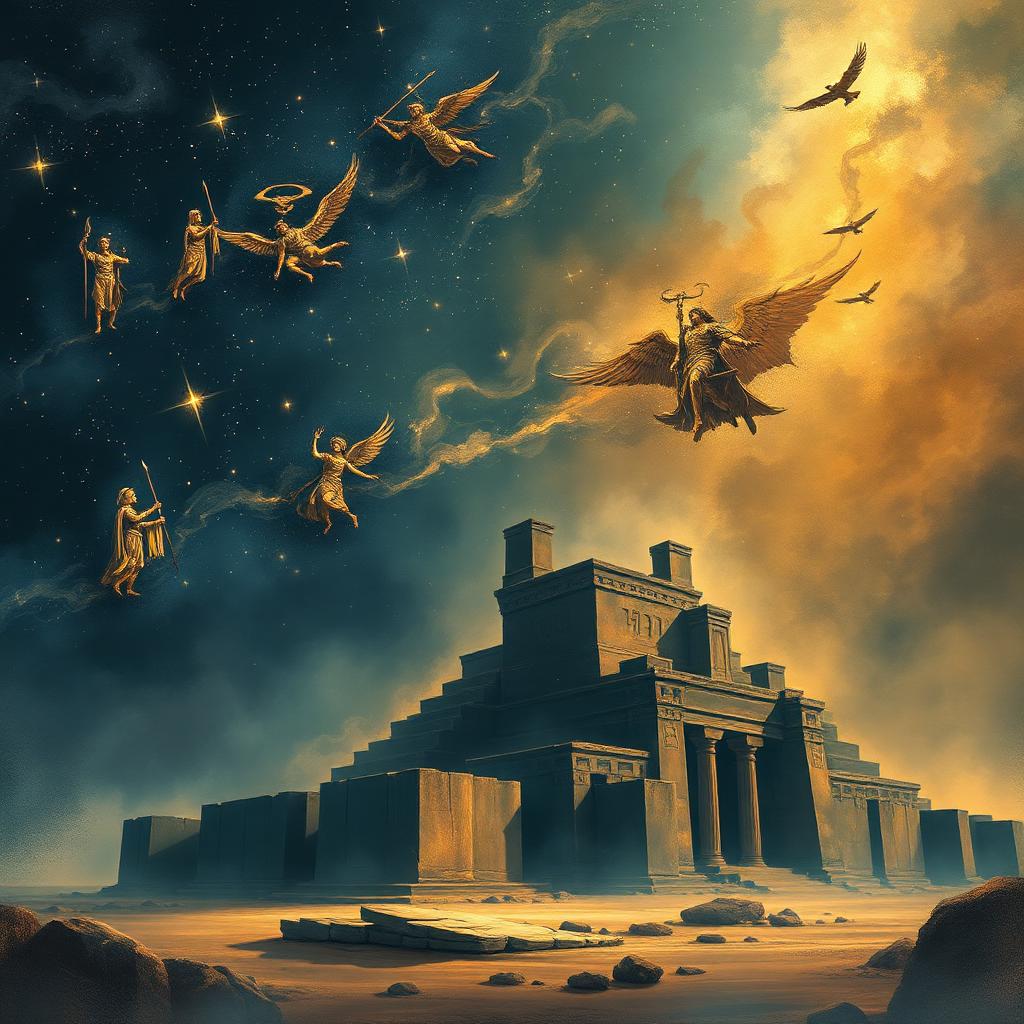
Long before the pyramids, civilizations across the world told the same stories — gods who descended from the stars, walked among mortals, and shaped the course of history. From the Sumerian King List to the Book of Enoch, from the Greek Titans to the Hebrew Watchers, ancient texts describe beings of immense power who ruled, taught, and warred. Were these merely myths? Or were they memories of something real — something that changed humanity forever? The Codex follows these threads across millennia, tracing where the records converge and where the truth still waits beneath the surface.
Then $9.99 one-time for lifetime access. No subscription. See what's included →
- 31
- Chapters
- 3
- Traditions traced
- ∞
- Questions answered
A Book of Research
Every name, every text, every claim — at your fingertips.
The Codex is not a summary. It is the book opened wide: a chapter-by-chapter companion that lets you interrogate the sources, see where traditions agree, and follow the author's reasoning straight to its origins.
What's inside
Four ways to read the book again.
Chapter Chat
Ask any chapter a question and get answers grounded in the text itself — citations, context, follow-ups.
Glossary & Entity Lookup
Instant definitions for every god, watcher, place, and text — drawn from the book's own vocabulary.
Convergence Map
See where Greek, Hebrew, and Sumerian traditions describe the same event — and where they diverge.
Make the Case
Choose any claim in the book and the Codex will reconstruct the reasoning, source by source.
Part One
The Timelines.
A narrative cosmology — from the divine assembly to the destruction of the giants.
- 01Timeline 1: The Divine Assembly→
- 02Timeline 2: Eden as Divine Sanctuary→
- 03Timeline 3: The Formation of Humanity→
- 04Timeline 4: The Seeds of Rebellion→
- 05Timeline 5: The Fall and Expulsion→
- 06Timeline 6: The Rise of Cities→
- 07Timeline 7: The Descent of the Watchers→
- 08Timeline 8: The Exchange of Knowledge→
- 09Timeline 9: The Strategy of Corruption→
- 10Timeline 18: The Great Catastrophe→
- 11Timeline 19: The Destruction of the Giants→
Parts Two & Three
The Research.
From the Sumerian Kings List to the Dead Sea Scrolls — the evidence, examined.
- 01Chapter 1: The Precession of the Equinoxes→
- 02Chapter 2: Dinosaurs→
- 03Chapter 3: The Council of Gods→
- 04Chapter 4: The Sumerian Kings List→
- 05Chapter 5: The Gap Theory→
- 06Chapter 6: The Garden of Eden→
- 07Chapter 7: Paradise Lost→
- 08Chapter 8: 1 Enoch and the Watchers→
- 09Chapter 9: Titans→
- 10Chapter 10. Megaliths→
- 11Chapter 11: Atlantis→
- 12Chapter 12: The Flood→
- 13Chapter 13: Sumer→
- 14Chapter 14: Babylon→
- 15Chapter 15: Tower of Babel→
- 16Chapter 16: Astronomy→
- 17Chapter 17: Giants 18th to 19th Centuries→
- 18Chapter 18: Giants in Mythology→
- 19Chapter 19: Important Lists→
- 20Chapter 20: Books of the Dead Sea Scrolls→
Lifetime Access
Open the Codex.
Start with a 3-day free trial. Unlock every chapter, every conversation, and every map — forever — for a one-time payment of $9.99 USD. No subscription, no renewals.
Create your account→Questions & Answers
What the Codex asks — and answers.
Drawn from the book where it speaks; from Hebraic and Torah tradition where it does not.
Where did the giants and their bones go?+
The Codex traces the giants — the Nephilim and their post-flood descendants (the Rephaim, Anakim, Emim, and Zamzummim) — through the conquest narratives, where Yahweh commands Israel to put them to the sword. The book follows their physical remains into the archaeological record: oversized sarcophagi like the iron bed of Og of Bashan (Deut. 3:11), elongated skulls and outsized femurs catalogued by 19th-century mound surveys in North America and the Caucasus, and bones repeatedly removed from public museums after the rise of modern anthropology. The author argues the bones did not vanish — they were buried, suppressed, or quietly reclassified once they no longer fit the accepted human timeline.
From the book
What were the Tower of Babel and other megalithic temples trying to accomplish?+
The book reads Babel and its sister structures — the ziggurats of Sumer, the step-pyramids of Mesoamerica, Göbekli Tepe, Baalbek — as deliberate attempts to re-open the contact made before the Flood: artificial mountains built to draw the sons of God back down. "Let us build a tower whose top reaches the heavens" (Gen. 11:4) was not a metaphor. The author connects this to the Watchers' descent on Mount Hermon in 1 Enoch and to the Sumerian belief that a ziggurat was a literal stairway for the Anunnaki. Yahweh's response — confusing the languages — was a counter-strike to prevent a unified humanity from re-establishing that gate.
From the book
Was the Garden of Eden actually another dimension?+
The Codex presents Eden not as a geographic location lost to erosion but as an overlapping reality — a place where the divine and physical realms touched. The four rivers (Gen. 2:10–14) anchor it to our world, yet the cherubim with the flaming sword (Gen. 3:24) guard a threshold that no expedition has ever found. The author aligns this with the Hebrew concept of the heavenly Mount of Assembly and with parallel "gardens of the gods" in Sumerian (Dilmun) and Mesopotamian texts — pointing to Eden as a higher-order space that was sealed off, not destroyed, when humanity was exiled.
From the book
How does the gap theory explain why Adam and Eve were new arrivals on the earth?+
Gap theory reads a vast span of time between Genesis 1:1 ("In the beginning God created the heavens and the earth") and Genesis 1:2 ("and the earth became formless and void"). In the Codex's framing, that gap holds an earlier creation — a world ruled by the sons of God that ended in catastrophe, leaving the fossil record, the ruined pre-Adamic civilizations, and the chaos Yahweh re-orders in the six days that follow. Adam and Eve are then the first of a new lineage, deliberately placed into a restored earth, which is why their genealogy is short, their language is given, and their dominion is granted from day one rather than evolved.
From the book
Did Yahweh give Adam and Eve dominion of the earth to clean up the mess the sons of God had created earlier?+
The book argues yes — the grant of dominion in Genesis 1:26–28 is restorative, not merely administrative. The sons of God had been entrusted with the nations and the pre-Adamic order (Deut. 32:8 in the Dead Sea Scrolls reading) and had corrupted it. Adam's commission to "subdue" the earth uses a verb of forceful re-ordering, suggesting territory that had been spoiled. The author reads humanity as Yahweh's counter-move: a new image-bearing species placed on the ground precisely to reclaim what the rebel divine beings had ruined — a commission later renewed in Noah, Abraham, and finally fulfilled in the Messiah.
From the book
How is Enoch important and listed in biblical texts?+
Enoch, the seventh from Adam, is the pivot figure of the entire pre-flood narrative. Genesis 5:24 says he "walked with God, and he was not, for God took him" — the only patriarch who never dies. He is named again in 1 Chronicles 1:3, cited as a prophet in Jude 14–15 (quoting 1 Enoch directly), and held up as a model of faith in Hebrews 11:5. The Codex follows the Book of Enoch — preserved intact in the Ethiopian canon and quoted by the Qumran community — as the indispensable backstory: it is Enoch who names the two hundred Watchers, records their teachings, and pronounces their judgment, supplying the context Genesis 6 only summarizes.
From the book